
Mental Resilience Off-Grid: What the First 3 Months of ‘Caravan Survival’ Taught Us
Full Transparency: I value your time and attention. You won’t find annoying pop-up ads here!
Instead, I use affiliate links. If you buy something, I may earn a small commission at zero extra cost to you.
I only recommend genuine solutions that actually serve our off-grid homestead, business, and homeschool life. Read my full Affiliate Policy for details.
The hardest part of building on a remote, steep hillside isn’t just navigating the terrain—it’s learning to design a life that respects the land rather than fighting it.
And, you don’t realise how much of your mental health is anchored to simple infrastructure until you’re driving an hour each way just for laundry, and you find luxury in a hot shower and a hand-painted shed.
Something to ask yourself, that I never even considered, “If you were to move onto your site tomorrow, do you know which small daily luxuries would actually be the anchor for your sanity during those first few months?”
This post is about finding the grit to push past the initial shock and start turning a raw site into a home – and keep your sanity.
After 3 months, our life in the Marlborough Sounds was a mix of intense labour and unexpected stillness. We were living in a caravan, but with my mother-in-law arriving from the UK for Christmas, we had a hard deadline to create something more permanent than a tent for her accommodation.
To work with the steep, continuous slope of our bush block, we leaned into our design and building backgrounds to create a ‘pod’ cabin system.
The goal was simple: build small, functional 10-square-metre huts, individually on piles, that could be constructed by just the two of us. Every component had to be manually portable so we could carry it into the trees by hand, yet robust enough to meet building codes and run off a simple solar-and-battery setup.
It was about creating a modular, functional solution that worked with the terrain rather than fighting it.
Carrying a House Down the Hill
The building process was a true test of grit. Every single stick of timber, every sheet of plywood, and every length of corrugated zincalume had to be carried 50 metres down a narrow bush track to a small clearing.
To keep costs down, we bought plain zincalume—the cheapest exterior cladding available. On hot summer days, I would lay the sheets out on the driveway and roll on thick black roofing paint so the structures would camouflage into the native bush. Once dry, we’d haul them down the hill, by hand, to the site.
To keep the build moving and our budget intact, we chose plywood for the cabin interiors—a decision that traded the slow, costly process of plastering for immediate structural strength. By whitewashing the sheets, we brightened the small 10-square-metre spaces while maintaining a clean, modern aesthetic that let the natural grain show through.
Beyond the speed of getting lined, this choice also gave us long-term flexibility; because the panels were simply screwed into place, we could easily unscrew them to adjust or repair wiring as our off-grid systems evolved.
The first of our tiny-home pods was nicknamed the ‘Bed Shed.’ It was exactly what it sounded like: a roof, four walls, and a bed. When my mother-in-law arrived, it was so fresh that we hadn’t even finished the decking above the forest floor. To get to her room, she literally had to ‘walk the plank’—a scaffolding board balancing across the joists to reach the door.
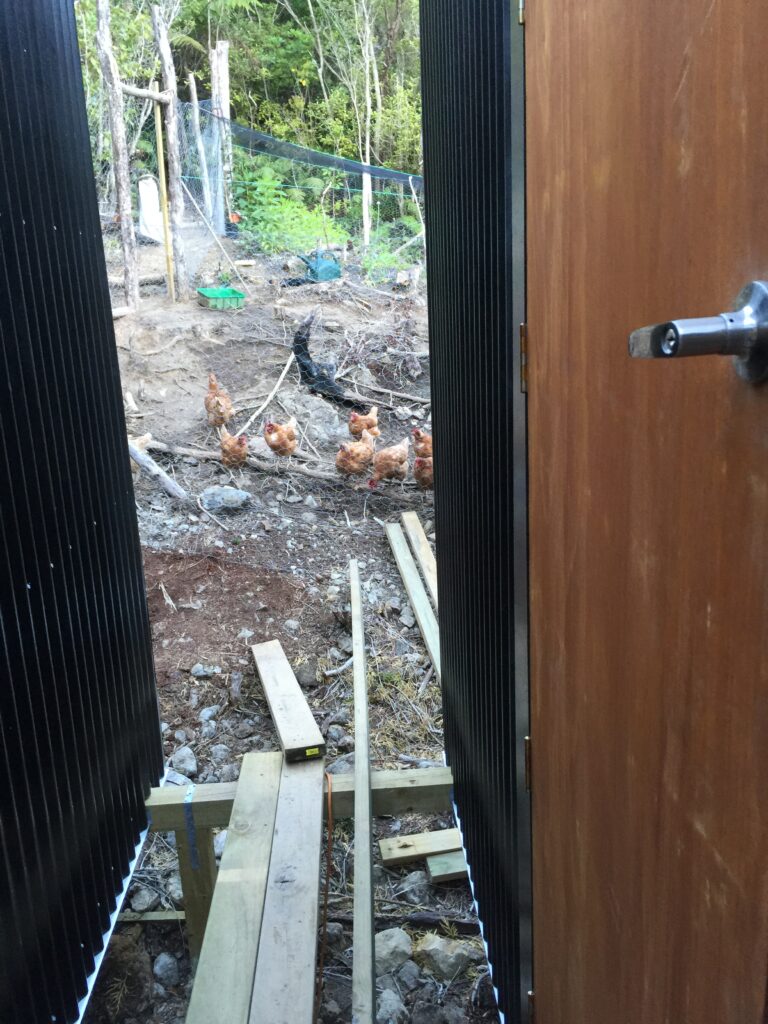
She’d leave the caravan in the evenings and walk into the darkness of the bush by lantern! We hadn’t even wired up the cabin yet, so it was a baptism by fire into the off-grid life, but she took it in her stride!
The Luxury of a Hot Shower
While we were building, we were also refining our systems. Living in the bush makes you realise that the things you once took for granted—like clean clothes and hot water—are actually massive engineering wins.
Two ‘upgrades’ changed our lives that summer:
- The Washing Machine: For the first few months, I spent one day a week driving an hour each way to a laundromat, sitting there with a two year old toddler just to get our clothes clean. We eventually installed a washing machine in a small steel garden shed near the caravan, powered by our generator and fed by a hose from the stream. It felt like winning the lottery!
- The Gas Califont: Shaving your legs and washing your hair with a tiny 10 litre caravan tank is an Olympic sport. And nearly impossible without the water running cold. We mounted a camping califont (a portable gas water heater) with a shower head to the outside of the caravan and popped it through the bathroom window. Suddenly, we had hot water that lasted longer than two minutes. Who knew that a tiny improvement like that was such a luxury!
When Peace Becomes Isolation
Those few months were also a strange, quiet time. With no phone reception, no TV and no internet, the world felt very far away. While my daughter had her afternoon naps in the caravan, I would sit on our lounge suite under the awning and read novels. It was the last time in eleven years I’ve had the stillness to truly get lost in a book.
However, by Christmas, the isolation started to settle in. We had the funds from our Queenstown house sale, but we knew that building our permanent home would eat through our savings quickly. We needed ‘bread and butter’ money and I wanted a connection back to a community.
On January 1st, 2015, I started looking for work. Fortune favoured us: a local farming store only 20 minutes away was hiring. I applied, got the job, and we had that stable steady income stream coming in.
Lessons from the First Few Months
- The ‘Pod’ Philosophy: If you are building on a remote or steep site, think in modules. Our 10sqm huts were manageable, met building codes, and allowed us to expand our living space as we could afford it.
- Camouflage by Design: If you can’t afford expensive ‘architectural’ cladding, buy the basics and paint them. Black or dark green matte paint helps man-made structures disappear into the native New Zealand bush.
- Invest in ‘Lifestyle’ Infrastructure: A washing machine and a gas califont might seem like ‘extras,’ but they are essential for long-term mental health. They save you hours of travel and provide the small comforts that make rugged living sustainable – and bearable!
- Local Networking is Key: Finding work 20 minutes away in a remote area is rare. Engaging with the local community early gave us more than just a paycheck; it gave us a sense of belonging in our new place.
Are you planning an off-grid build? I highly recommend looking into portable gas califonts for your outdoor shower setup—they are a total game-changer for temporary living.
About the author: Drawing from over a decade of off-grid living, I share relatable strategies and practical insights to help you navigate the complexities of homesteading, homeschooling, and business! Find out more about me…
Kirsteen
Author, The Off Grid Canvas
Leave a Reply